
Summary: Why do data centers need battery energy storage systems (BESS) for AI workloads? Standard data centers were built for predictable power, and AI power needs are volatile, spiky, and extreme. Enter BESS – a critical component of modern data centers. These systems act as a buffer between volatile AI loads and the grid, protecting infrastructure while smoothing power delivery. Alsym’s Na-Series sodium-ion battery line was purpose-built for this role.
Built for Marathons but Running Sprints
In just the past few years, the demand for AI tools has upended data center power structure. Training and inference clusters careen between idle gaps and full-tilt spikes, creating volatile swings in mere milliseconds. According to Goldman Sachs, 2027 AI server rack designs will require 50× the power of the server racks that power the internet today. Legacy conductors and breakers were not built for those power needs.
Extreme GPU cluster switches have even driven voltage flicker in the grid. Violent bursts swing from a 30% idle state to 100% processing utilization in milliseconds, which can cause destabilizing voltage and frequency deviations on the power lines. This grid-level impact was unheard of in the past.
Newly constructed data centers can be designed for today’s power from the foundation up, but existing centers can still be equipped to bridge the power gap.
The Power Solution: High-Throughput Buffering for Burst-Driven AI Workloads
Nearly every element of a data center needs to be reconfigured to accommodate burst-driven AI workloads, but BESS does the heavy lifting to solve a range of issues within existing design constraints.
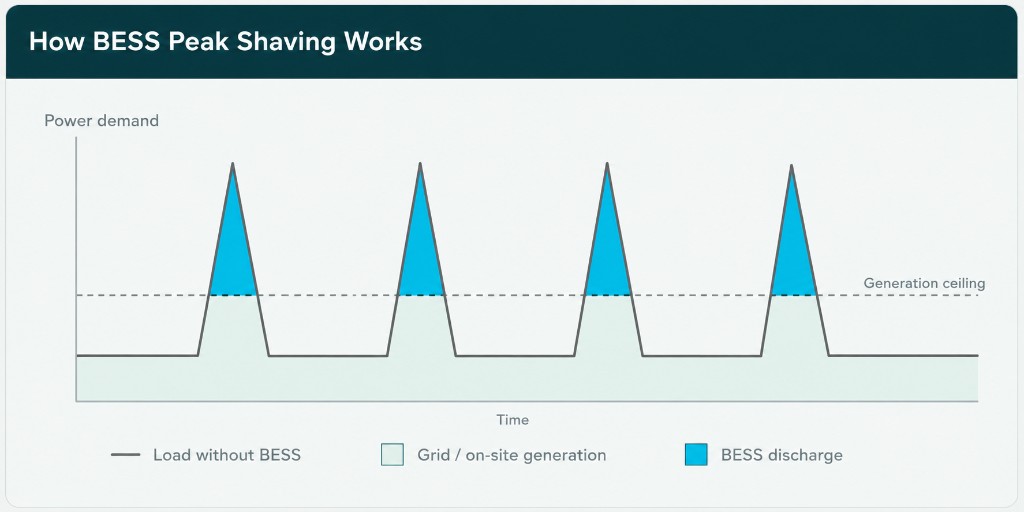
A 2C battery functions as an industrial-sized “shock absorber” upstream of the white space. It has the rate capability to aggressively ingest excess power when the processors drop to an idle state and instantly throw high-throughput active power back onto the central bus to smooth intense matrix computations.
Volatile power curves from AI training workloads can also stress equipment to the point that they put upstream infrastructure at risk. Data centers need to isolate these transient loads from the grid to protect upstream systems.
Plus, the past approach of scaling battery volume to add capacity doesn’t fit AI’s transient power spikes well. Centers need high-rate discharge chemistries that deliver more power without a footprint increase. To mitigate the BESS footprint and volumetric constraints, a BESS with a high-power rate capability allows operators to downsize and keep the structural footprint of the external energy storage yard while maintaining peak load-shaving performance.
This can benefit data center operations in two distinct scenarios:
Fully BTM: when complementing on-site generation in response to peaks in demand in a fully behind-the-meter generation situation
Grid-connected: when pulling from BESS instead of the grid during periods of high AI server use.
Example 1: BESS complements on-site generation in response to demand peaks when power is generated fully behind-the-meter.
Example 2: Data center pulls energy from BESS during times of high server activity
Building the Future with BESS – What battery works best?
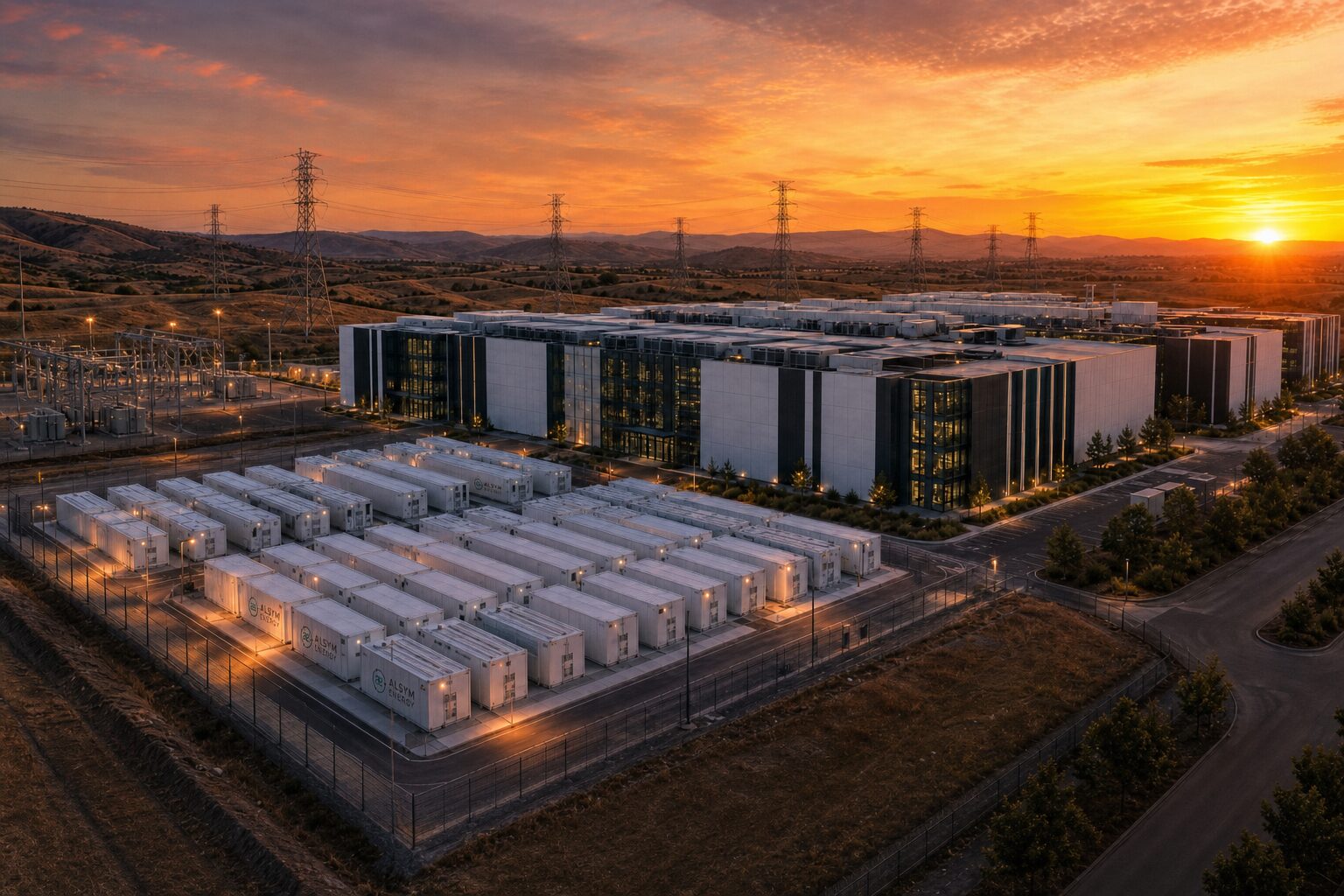
Alsym Energy’s Na-Series sodium-ion battery line, powered by its proprietary NFPP+ chemistry, was purpose-built for these conditions. Designed for high-utilization environments, heavy cycling, and long operating life, Na-Series handles large-scale power swings that characterize AI workloads while supporting more resilient power architectures.
Specifically, Alsym checks the boxes with:
- High C-Rate Is Standard: Alsym cells built to tolerate 2C continuous charge and discharge with 30-second pulse to 3C.
- Passive Cooling: Alsym’s NFPP+ chemistry operates stably across an extreme temperature range (-40°C to 60°C), meaning it can manage intense discharging while only using passive cooling, unlike less stable batteries that require intense active cooling.
- Superior Cycle Life 10,000 cycles: Engineered for high-frequency cycling to handle rapid load oscillations without premature degradation.
- High-Density Footprint: High C-Rate BESS can solve data center load swings with an industry-leading footprint similar to that of a two-hour LFP BESS without the thermal management penalties. Thermal management can require flywheels and other large-footprint equipment.
Net new, purpose-built AI data centers include higher-voltage DC distribution like the 800VDC architecture, liquid cooling, and power architectures designed around volatility rather than averages. Existing centers built for steady power instead of spiky swings were set up with completely different infrastructure, and bridging the gap is critical to ongoing operations.
Historically, those building data centers had to choose between power batteries with shorter life cycles that sell at a premium, or more frequently replacing standard 4-hour LFP batteries that wear down under the intense use.
BESS built with sodium ion is an ideal solution for these scenarios. Alsym’s Na-Series batteries are both power and energy batteries, equipping newly built centers and retro-fitting legacy architecture with the ability to handle the nature of modern power.
Together, these capabilities position Na-Series to help power a faster, safer, more affordable, and more scalable energy future. Learn more about the future of sodium ion at data centers here.