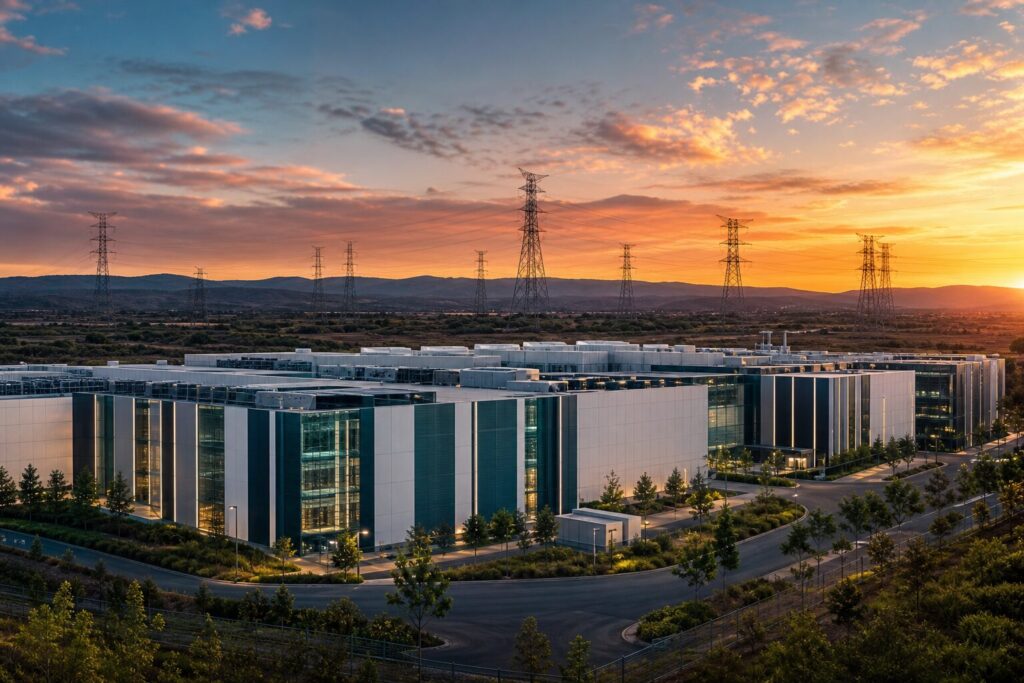
Artificial intelligence is transforming more than how microchips and processors are used inside a data center. It is also creating major shifts on the power delivery infrastructure in and around data centers.
To cope with larger compute loads, AI data centers are growing larger, installing processing unit racks over 5× more powerful than traditional CPU racks, with denser power demand, and far more dynamic power demand profiles. According to BloombergNEF, AI-driven growth is expected to transform the role of storage and flexible power systems in supporting new data center capacity and grid integration.
In short, the next generation of data centers will not simply consume more electricity, they will consume it in more challenging ways.
One glance at the following graphs clearly shows how AI workloads are creating a new class of energy delivery challenges – and at a time when energy demand has never been higher.
AI training and inference workloads create rapid fluctuations in power demand that traditional architectures were not designed to manage. Historically, power systems inside data centers were optimized around uptime, but AI introduces sharper load swings and significantly higher power densities. This poses a challenge for power quality control – which some data center operators are using energy storage to smooth.
While time spent by AI tools in the training phase is shorter than the inference phase as models mature, it will still affect power demand spikes. Add to this the increased energy needed to run AI datacenters even after the training phase – i.e. inference phase load – and it’s a totally new territory for power.
If that’s not enough of a challenge for data center owners and developers to tackle, they also have to bridge the “chasm” between when a data center can be physically completed – estimated at within 3 years – and time to interconnection – estimated at 5 to 7 years.
To meet the unstoppable demand for AI, the industry is innovating around this chasm. In fact, just over one-third of data centers in 2030 are expected to have completely onsite generation, though the focus in the near term remains on temporary bridge-to-grid power (Bloom Energy, 2026). They’re even branching out with solar + storage off-site power purchase agreements.
But most developers are not pursuing permanent off-grid operation; they are treating on-site generation as a transitional “bridge-to-grid” strategy, i.e. bringing capacity online behind the meter to accelerate deployment while locating facilities near substations that enable future grid connection. Even among projects evaluating off-grid power supply, most still ultimately require a path to the grid, a decision riding on the lower long-term cost of grid power and the reliability and stability services the grid provides.
Beyond interaction with the grid, power delivery architecture within the data center itself is changing. Industry roadmaps increasingly point toward 800 VDC distribution architectures that move more power more directly to the increased compute loads generated by higher-power GPUs. While 800 might seem like an arbitrary number, it’s actually the voltage where current drops low enough to reduce copper loss and thermal burden.
In this environment, energy storage is no longer optional — batteries are becoming a foundational layer of AI data center design. Their integration can help to stabilize operations, improve speed-to-power, support resilience, and manage interaction with the grid.
Importantly, batteries are no longer tied only to renewable energy systems – in fact, integration with gas turbines or fuel cells is emerging as a method for onsite generation. BloombergNEF has identified 4.9GW of planned storage deployment tied to data center growth is expected to be co-located with fossil generation assets, underscoring that storage has become a flexible infrastructure layer regardless of generation source.
A forward-looking AI data center design does not choose between two battery systems – it will deploy a hybridized energy architecture based on myriad strategies. A high C-rate asset may sit close to the power distribution bus to stabilize micro-transients generated by compute infrastructure, while a utility-scale battery energy storage system (BESS) manages grid integration, economics, backup duration, and multi-hour resilience.
Different batteries solve different problems—and the architecture works because these systems operate together.

1. Utility-Scale Energy — 4+ Hour BESS for Capacity and Renewable Integration
AI data centers increasingly rely on integration of BESS with a mix of on-site fossil-fuel-based and renewable energy generation to provide dependable baseload power, while using renewable energy to support carbon reduction goals. This architecture is being adopted both to bridge interconnection delays by enabling facilities to secure power before grid access is available and, more commonly, by independent power producers (IPPs) and developers using BESS-enabled utility-scale projects to support large, long-term power purchase agreements (PPAs) with data center operators.
- Leveraged by AI data centers and energy storage developers alike.
- Accelerate grid interconnection.
- Added capacity when utility lines are curtailed.
- Support renewable integration.
- Reduce reliance on conventional backup generation.
2. Utility-Scale Power — High C-Rate (2C) Load Smoothing Power Battery
A load-smoothing battery can address violently spiking data center power demand that can destabilize voltage and cause frequency deviations on the power lines. As AI workloads create large, facility-level power swings from synchronized GPU clusters shifting between training, idle, and inference states, utility-scale batteries are increasingly needed to dynamically absorb and smooth these MW-scale fluctuations—reducing reliance on inefficient “dummy loads” used to maintain stable operating conditions for on-site generation assets.
- High C-Rate (2C) load smoothing power battery.
- Functions as an industrial-sized “shock absorber” upstream of the white space.
3. Off-Grid Integration of Gas Turbines + BESS
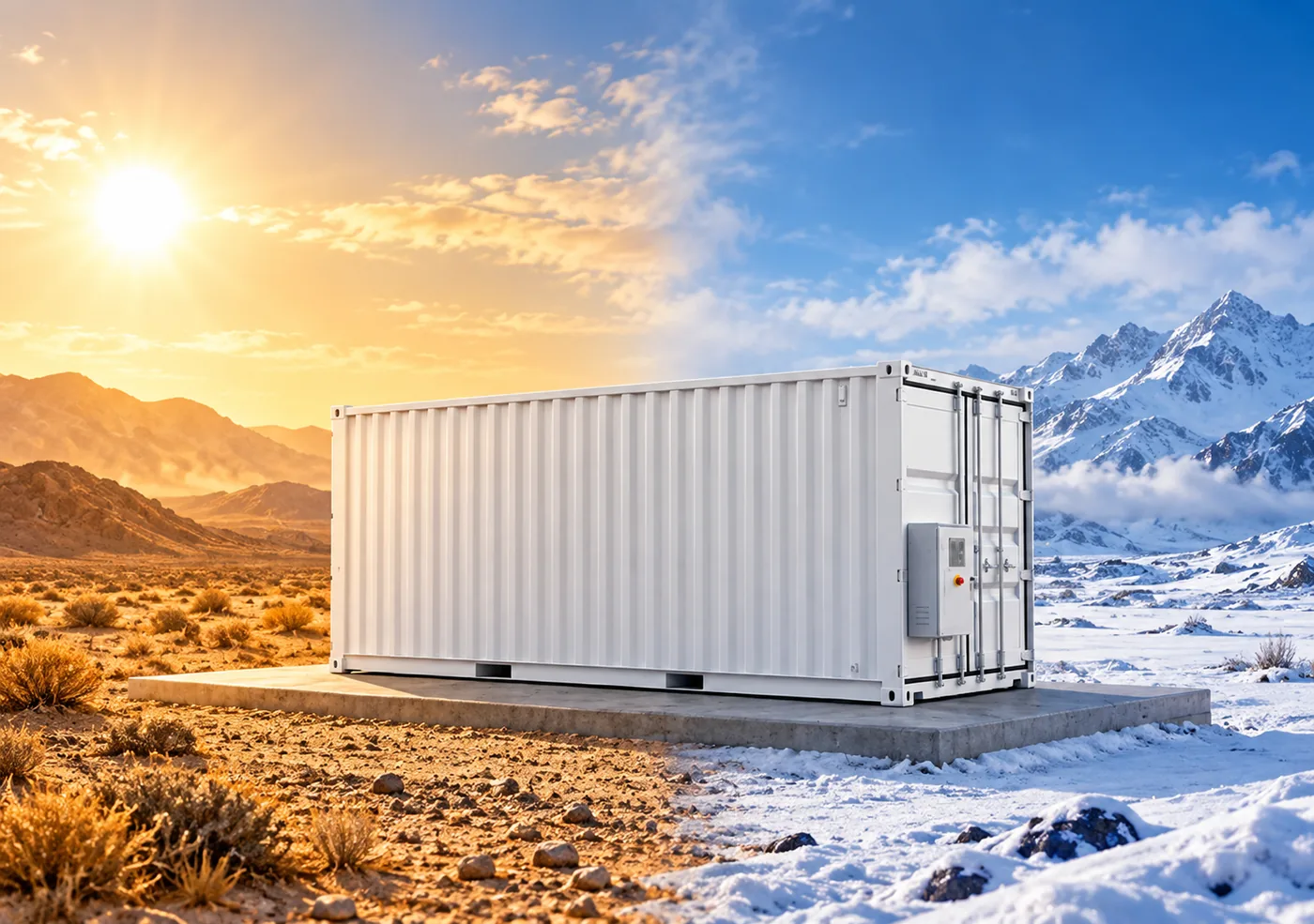
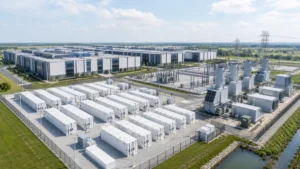
Data centers often demand more power than their local grid can provide. An outdoor battery yard integrated with gas turbines can handle multi-hour load shifting, absorb generation fluctuation and make black-starts possible. As a growing share of new AI data centers pursue behind-the-meter and off-grid energy strategies to avoid interconnection delays, combining BESS with on-site generation allows operators to maintain reliable power while optimizing generation assets—keeping gas turbines operating at efficient steady-state loads while batteries manage rapid load changes.
- Grid Forming BESS for Gas Turbine Integration.
- Creates flexibility in microgrid design.
4. DC Distribution — Next Generation 800 VDC
Next-gen 800VDC architecture moves larger amounts of power more directly to the increased compute loads generated by GPUs. As AI workloads drive rack power densities beyond the practical limits of conventional AC distribution, 800 VDC architectures are emerging as the preferred approach to deliver stable, efficient, and scalable power to next-generation compute environments.
- Battery systems integrated directly to the DC bus for immediate active power injection.
- Actively stabilize grid voltage and frequency during massive utility disturbances.
5. GPU-Level BESS
Data centers are vulnerable to power delivery interruptions and transient voltage fluctuations – rack level batteries can suppress their negative influence on the IT rack. As AI workloads create increasingly abrupt, localized power swings at the GPU and rack level, GPU-level BESS acts as a first line of defense to absorb these fast transients before they propagate into facility-wide power disturbances or grid-level instability that could impact broader operations.
- GPU level DC battery & decentralized UPS.
- Ensures immediate, uninterrupted power is delivered to the rack.
6. Load-Smoothing UPS — Centralized AI Backup
Uninterruptible power supplies (UPS) conduct rapid, real-time compensation during grid sags and faults, keeping IT loads operational. Load-smoothing UPS systems are increasingly deployed to absorb rapid load fluctuations, provide transition power during outages, and act as a real-time electrical buffer that protects operations while helping large-scale AI facilities remain within utility interconnection and power quality limits.
- Centralized AI backup.
- If primary grid is lost, batteries act as a ride-through power.
These emerging cases have major implications for the infrastructure that supports AI data centers – the type of battery used does too.
As batteries move closer to the core of data center operations, chemistry selection and battery design become increasingly important. Each use case requires a unique combination selected specifically for the specifications and performance requirements – it’s not the case that lithium-ion chemistry can be applied in a blanketed fashion across all applications.
Lithium-ion remains the dominant commercial technology, but concerns around thermal management, fire risk, and cooling requirements are driving interest in alternatives.
Sodium-ion technologies are emerging as one pathway for reducing thermal management burden while improving lifecycle durability in data center environments.
The energy architecture for AI data centers is becoming layered, distributed, and storage-centric. The question is no longer whether batteries belong in data centers—it is which battery chemistries and architectures fit each use case.
Additional Sources:Bloom Energy, 2026 Data Center Power Report (January 2026); BloombergNEF, Data Centers’ Energy Storage Ramp Up: AI Drives New Uses (April 2026); Schneider Electric, White Paper 213