– By Spencer Nervig, Battery Solutions Architect at Alsym Energy
The role of batteries in conventional data centers was simple: they lived in the UPS room and bridged the gap between a utility outage and the moment diesel generators caught.
In an AI factory, it’s more complicated.
What’s Different About AI Data Centers?
AI data centers are not just larger versions of traditional data centers – they introduce a different kind of power challenge. For one, they need a lot more of it: The U.S. alone may add 58 GW of new data center capacity between 2026 and 2030, according to Benchmark Mineral Intelligence. For two, they will need it delivered much more intensely: GPU-optimized AI facilities are already moving from 50–100 kW racks toward next-generation, liquid-cooled designs that can push beyond 200 kW per rack, and experts suggest 1MW racks could be achieved by end the decade.
And the fun doesn’t stop there: power behaves much differently in AI factories as well. Large GPU clusters do not draw power in a smooth, predictable line. At the server rack, sharp millisecond-scale current and voltage spikes can be created by the GPU, memory, networking, and power-conversion activity, which must be buffered locally to keep voltage steady. Aggregated across thousands of GPUs, those fast disturbances sit on top of larger workload swings as clusters move between compute, communication, and checkpointing phases. Together, these dynamics can stress on-site electrical infrastructure, create power-quality issues, drive demand charges, and, at campus scale, impact the broader electric grid.
Bring In the Batteries
One of the few power technologies flexible enough to get AI datacenter loads under control is energy storage. In AI factories they can perform roles spanning backup power, peak shaving, load shifting, renewable firming, frequency response, AI load smoothing, and speed-to-power when the grid connection is constrained.
The nuance is that these use cases aren’t a function of just one battery system. A centralized BESS at the grid interconnection can help with peak shaving and capacity shifting, but it is challenged with microsecond-level GPU transients at the rack. Likewise, rack-level storage can smooth fast load swings, but it is not the right tool for multi-hour energy shifting.
Because AI power volatility appears at different electrical boundaries and over different timescales, storage has to be distributed across the architecture. Fast rack-level transients prefer storage close to the compute load, while slower facility- and campus-level power swings can be managed farther upstream at the facility or grid interconnection, where they can shape the load before it propagates into the broader power system.
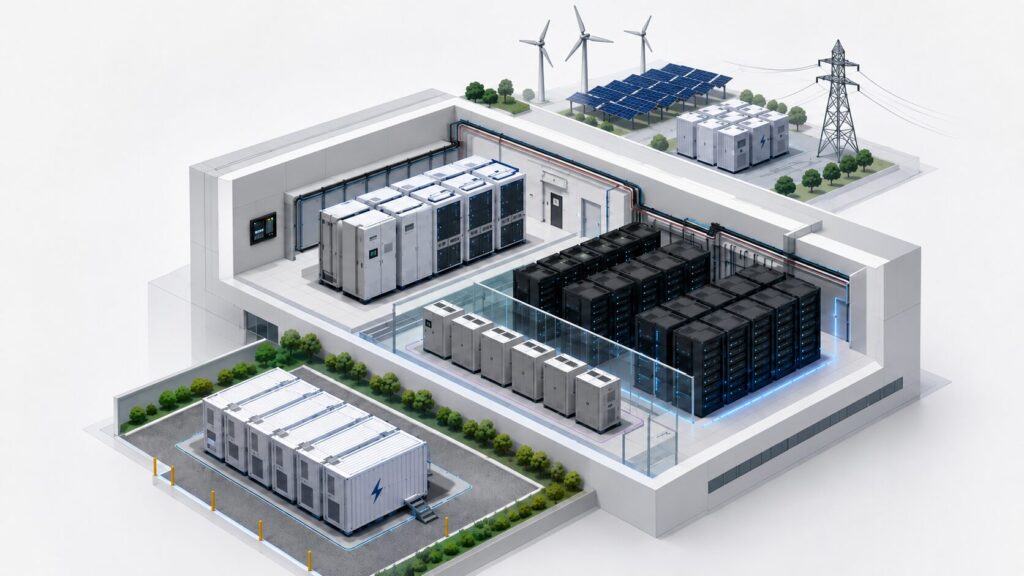
NVIDIA frames the spread of needs as a multi-timescale strategy: near-rack capacitors and supercapacitors handle millisecond-to-second fluctuations, while larger facility/interconnection BESS handles seconds-to-minutes workload ramps and ride-through during backup-generator transfers. The broader power stack then extends this logic into minutes-to-hours grid-edge storage for peak shaving, load shifting, and interconnection bridging. The chart below gives of a visual of the concept:
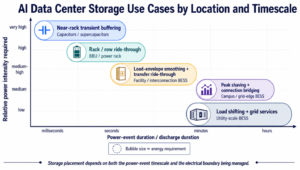
1. At the Rack: The High-Frequency Transient Layer (Milliseconds to Seconds)
At the fastest timescale, the challenge is instantaneous output, not continuous power. At the rack, GPU workloads are accompanied by sharp millisecond-scale current and voltage transients from GPU, memory, networking, and power-conversion activity. These high-frequency power spikes must be buffered to prevent voltage dips, equipment stress, and power-quality noise from propagating upstream. The common tool at this front-line are high-power capacitor and supercapacitor banks placed close to the compute racks, often packaged as capacitor backup units, or CBUs.
The placement matters as much as the device. The closer this buffer is to the IT load, the less of the transient propagates into the wider electrical infrastructure. Its defining requirement is raw power density and switching speed, not stored energy. High-voltage batteries can work here, but electrochemical batteries are currently not the best instrument for this layer; their role begins where the capacitors end.
2. At the Rack and Row: The Ride-Through Layer (Sub-seconds to Seconds)
Immediately downstream sits a short-duration ride-through layer. In emerging 800VDC designs, this may live in dedicated power racks positioned adjacent to the IT racks or in battery “pods” that serve an entire row. Vendors are already moving in this direction: Delta has released in-row power racks with embedded battery backup units and Vertiv is releasing an 800VDC data center power portfolio including power conversion and battery backup infrastructure needed to bring short-duration storage closer to AI server racks.
The premium capability here is high C-rate delivery for brief, repeated discharges during source transfers and short IT-layer load events. Because these systems are sited close to load, there is also an important practical constraint: traditional containerized BESS does not fit inside the data center fabric. At this layer, form factor, safety, and integration with power distribution can matter greatly.
3. At the Facility: The Low-Frequency Load Envelope (Seconds to Minutes)
This is where the architecture’s center of gravity is shifting. An energy storage backbone makes it practical to integrate larger, facility-level storage at a more effective point in the power train. This layer manages the low-frequency load envelope: the seconds-to-minutes ramp-up and ramp-down of training jobs, ride-through during transfers to backup generation, and smoothing of the facility load seen by the grid.
The requirement now inverts relative to the rack. Energy, cycle life, safety, and OpEx dominate, while raw power density recedes. This is also where the old mental model of a rarely used UPS starts to break down. If storage is absorbing AI workload ramps, managing power quality, and supporting source transfers, it may cycle deeply and continuously inside a dense, thermally stressed facility. The selection premium shifts toward a chemistry that is inherently safe, long-lived, and tolerant of frequent use without becoming a cooling or augmentation problem due to the heavy, frequent use the battery must endure.
4. At the Campus or Grid Interconnection: Utility-Scale Storage (Seconds to Hours)
Aggregated across a hyperscale or gigawatt-scale campus, facility load swings can become a direct threat to the local grid. This turns interconnection into a primary bottleneck for AI scaling and creates a different role for storage: decoupling the data center’s volatile draw from its connection limit. At this layer, BESS can support peak shaving, load shifting, demand charge reduction, grid services, renewable firming, and speed-to-power while the full grid connection is still years away.
This is the layer most aligned with conventional stationary storage economics. The system is larger, more centralized, and sized around hours rather than milliseconds. Some operators are also pushing this function to the grid edge with medium-voltage UPS at the connection point. The key criteria are LCOS, safety, cycle life, supply chain resilience, and the ability to cycle economically without compromising the uptime requirements of the data center.
The Alsym Perspective
Data centers and other large loads are turning to storage for more than backup. Interconnection bridging, AI load smoothing, peak shaving, grid services, and backup are each becoming standalone requirements, and each pushes batteries harder than the idle UPS duty cycle data centers once planned around.
Across these use cases, the benchmark is converging: heavy sustained cycling, proximity to the load, minimal thermal overhead, high availability, and economics that hold up after cooling, augmentation, safety infrastructure, and asset-life degradation are counted.
That is where LFP is exposed. Under aggressive cycling, degradation accelerates. Flammability pushes systems farther from the load and adds setbacks and siting complexity. Cooling consumes facility power that operators would rather allocate to compute. And many conventional systems still force trade-offs between power, energy, safety, and usable floor space.
Storage built for this benchmark looks different. Alsym’s Na-Series is a non-flammable sodium-ion NFPP+ platform designed for designed for AI data centers with demanding stationary operation: frequent cycling, safer siting, lower thermal overhead, and lifetime total cost of ownership rather than upfront cost alone.
Read more about how Alsym’s Na-Series platform fits the AI data center power stack, or explore the NFPP+ technology behind it.