As the global demand for high-performance batteries accelerates, the limitations of lithium-ion – ranging from supply chain fragilities, plateauing performance improvements, to thermal runaway risks – have become impossible to ignore. These realizations have pushed sodium-ion back into the spotlight, and it’s not just a chemistry experiment anymore. According to Morgan Stanley, sodium-ion is becoming an $800 billion capital formation wave by 2035, as the technology scales from pilot to industrial deployment.
Sodium-ion was developed decades ago but was overlooked because the market prioritized high energy density for electric vehicles. But a shift has occurred positioning sodium-ion as a resource-secure and cost-effective path forward for our future energy system, particularly for energy storage. Sodium-ion batteries utilize sodium carbonate (soda ash), which is over 1,000 times more abundant than lithium and highly stable in pricing. The technology also possesses some distinct advantages over lithium-ion such as longer cycle life, faster discharge rates, wider operating temperature range, and importantly, enhanced safety.
However, sodium-ion technology is not a monolith. Today, its electrochemical nature is well understood and the market has segmented into three primary chemistry families defined by their cathode structures: Layered Metal Oxides, Prussian Blue Analogues, and Polyanionic compounds. Each sub-type has distinct performance profile, material characteristics, and operational trade-offs that directly dictate their commercialization paths and product-market fit. Read on to learn more about the three main sub-types of sodium-ion:
1. Layered Metal Oxides (LMO): The High-Density, Low-Cost Option for Micromobility
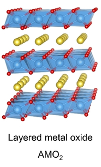
Layered transition metal oxides (LMO) share a structural blueprint highly similar to nickel-based lithium-ion chemistries, consisting of alternating sheets of sodium ions sandwiched between layers of transition metal oxides. This tightly packed arrangement excels in energy density, typically achieving 140 to 160 Wh/kg, making it the leading choice for compact, space-constrained applications among sodium-ion. Commercial LMOs typically adopt either an O3-type structure, where sodium occupies octahedral sites, or a P2-type structure, where sodium occupies prismatic sites. While O3 structures offer higher initial sodium capacity, they suffer from severe, irreversible phase transformations at higher voltages, leading to rapid volume expansion. Conversely, P2 structures boast faster ion diffusion kinetics enabling “fast charge” and better structural stability but suffer from lower initial capacity because not all sodium can be extracted without causing structural collapse.
These atomic-level mechanics directly dictate the commercialization strategy for Layered Oxides. Because LMO chemistries typically yield a lower cycle life of around 3,000 cycles, they are economically ill-suited for the multi-decade lifespans required large-scale energy storage systems. Furthermore, at high states of charge, the transition metals on the cathode surface trigger exothermic reactions with the organic liquid electrolyte, releasing oxygen under high thermal stress which can lead to self-sustaining thermal runaway just like lithium-ion batteries. Because of these safety and lifespan boundaries, manufacturers have funneled LMO commercialization toward entry-level short-range light electric vehicles and micromobility applications like e-scooters and e-bikes. In these mobility sectors, the market prioritizes lower upfront cost and high volumetric energy density rather than safety and service life. This allows LMO to capture market share where the main barrier is affordability for the average consumer.
2. Prussian Blue Analogue: The High-Power Specialist
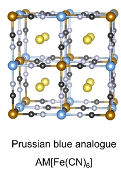
Prussian Blue Analogues (PBA) utilize a unique, open three-dimensional framework composed of transition metal hexacyanometallates. They possess unusually large interstitial sites that permit rapid sodium-ion insertion and extraction. Because of these rapid kinetics, PBAs can deliver impressive C-rates, allowing them to discharge massive bursts of power and recharge rapidly while benefiting from low raw material costs.
Prussian White (PW) is the primary chemical variant driving commercial cell development, which is simply the fully sodium-loaded version of Prussian Blue. For most commercial applications, Prussian White cathodes are paired with a hard carbon anode.
While these hard carbon-coupled Prussian White cells offer an attractive balance of material availability and fast-charging capabilities, the chemistry faces a notable challenge with trapped moisture. Microscopic vacancies naturally form in the crystal framework during production, easily drawing in and trapping water molecules. When the battery cycles, this internal moisture breaks down electrochemically, sparking gas generation, rapid internal resistance spikes, and physical cracking of the cathode particles. Additionally, rapid or deep discharging forces the crystal lattice to distort from a stable cubic shape into asymmetrical structures, which pulverizes the cathode over time and lowers overall cycle life. From a safety perspective, severe mechanical or thermal abuse above 200°C also carries the risk of decomposing the cyanide bonds, potentially releasing toxic hydrogen cyanide gas.
Commercialization for PBA is moving in two distinct directions. Developers are scaling Prussian White for large-scale grid energy storage (BESS), leveraging its low-temperature resilience and abundant material framework to provide a fast-responding, sustainable asset for utility infrastructure. Second, companies are aggressively targeting the automotive starter battery market as a drop-in successor to legacy lead-acid batteries—offering safe zero-volt storage, superior cycle life (8,000 cycles to lead acid’s 500 cycles), and significantly better operational reliability across harsh (particularly low-temperature) climates.
3. Polyanionic Frameworks: The New Benchmark for Grid Storage
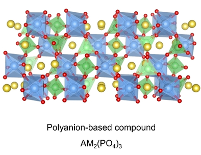
Polyanionic materials feature rigid, three-dimensional frameworks built around strong covalent bonds, typically built from tetrahedral phosphate or pyrophosphate groups. Within this category, a formulation analogous to lithium iron phosphate known as sodium iron pyrophosphate (NFPP) has emerged as the definitive benchmark for large-scale energy storage applications.
The secret to NFPP’s unrivaled structural longevity and safety lies in the quantum mechanics of the inductive effect. In layered oxides, transition metals are bound to independent oxygen atoms, which easily break and release oxygen gas during high-temperature abuse. In NFPP, strong covalent bonds form tetrahedral (PO4)3 and (P2O7)4 clusters. The phosphorus atoms hold onto the oxygen atoms with an iron-clad grip, resisting oxygen release even if the battery undergoes severe external short circuits, high overcharge, or physical crush events.
This rigid 3D framework provides open tunnels for rapid and highly-efficient sodium-ion diffusion. Unlike layered sheets that expand and contract with each cycle, releasing heat and gradually wearing down the battery, the NFPP framework experiences near-zero volume change during insertion and extraction, preserving mechanical integrity to deliver an extraordinary lifespan of 10,000+ cycles with exceptional round-trip efficiency.
This makes NFPP the definitive commercial choice for battery energy storage systems (BESS). The thermal stability slashes the need for energy-intensive active liquid cooling infrastructure, allowing project developers to rely on passive or simple air cooling instead.
The Alsym Perspective
At Alsym Energy, our analysis of the grid-scale market indicates that evaluating a battery technology purely on cell-level energy density misses the larger economic picture. For utility-scale energy storage, the ultimate metrics of success are Levelized Cost of Storage (LCOS), safety, and system-level operational expenses (OpEx). As detailed in our white paper Assessing the Promise & Potential of Sodium-ion in 2026, the true economic advantage of sodium-ion is best demonstrated in a system context when you eliminate the costly, complex engineering control add-ons required by volatile chemistries.
By utilizing the inherently stable, non-flammable polyanionic NFPP chemistry, operators can entirely bypass the phase-transition decay of layered oxides and the lattice-water degradation of Prussian blue. Because NFPP eliminates the structural pathways that lead to thermal runaway, these systems can rely on passive or air cooling instead of heavy active liquid cooling infrastructure, reducing cooling energy consumption by up to 90%. Furthermore, because sodium-ion cells utilize aluminum current collectors on both electrodes, they can be safely discharged down to 0 volts for non-hazardous transport and storage. Capable of scaling rapidly using existing lithium-ion manufacturing lines through simple “drop-in” tool conversion, polyanionic sodium-ion represents the most pragmatic, reliable, and high-ROI path forward for global energy storage infrastructure.
Learn more about the newest generation of polyanionic sodium-ion NFPP+ technology.
Atomic structure graphics sourced from Review on Cathode Materials for Sodium‐ and Potassium‐Ion Batteries: Structural Design with Electrochemical Properties. Batteries & Supercaps. 6. 10.1002/batt.202200486. (2023)