
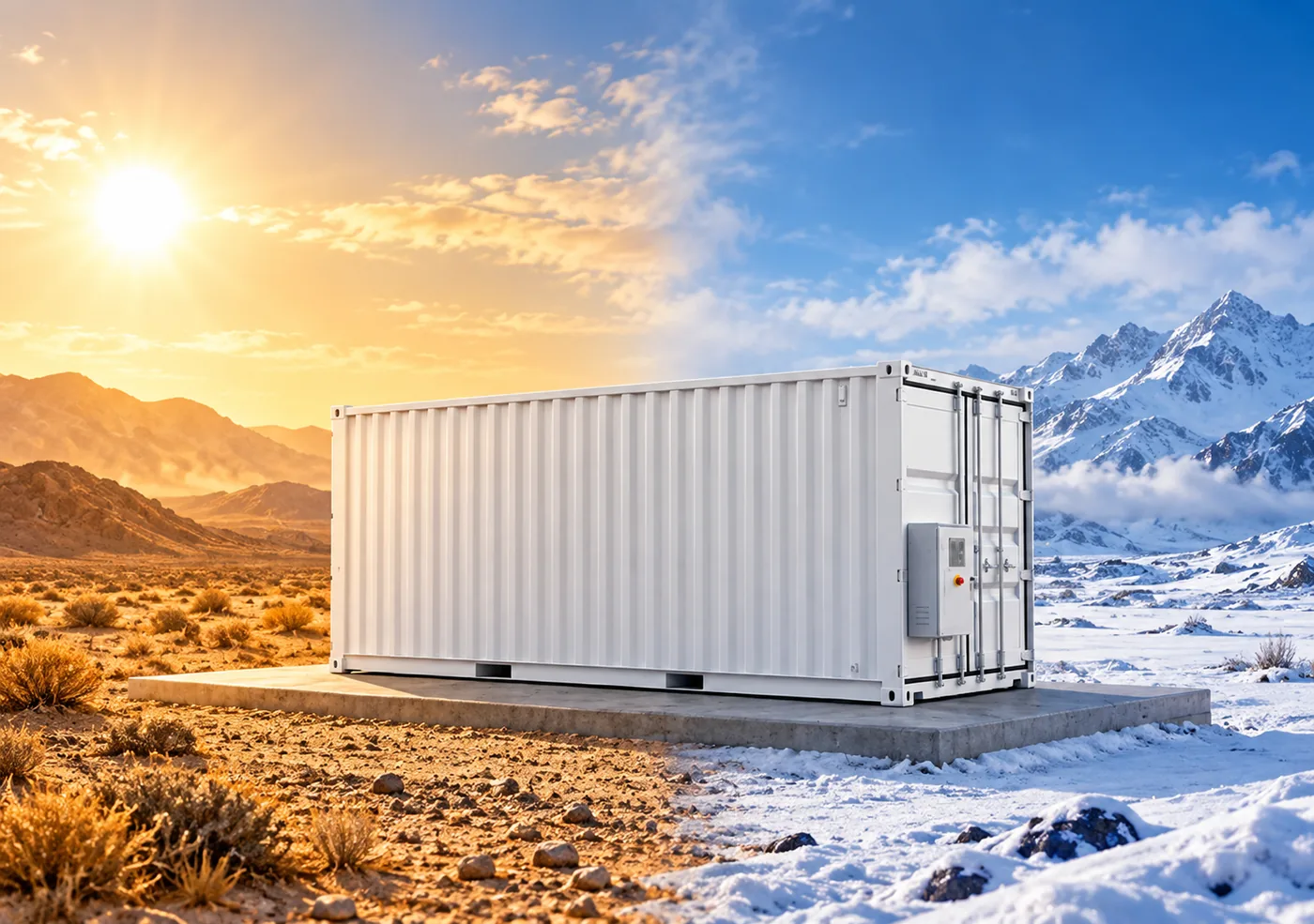
For grid-scale storage, cycle life, a wide temperature range, and intrinsic safety are more consequential than upfront $/kWh because they directly affect the system’s lifetime economics and operational reliability and flexibility.
Cycle life is the number of complete charge-and-discharge cycles a battery can perform before its capacity falls below a specified level, such as 80% of its original capacity. A high cycle life means more usable energy over the asset’s life. A wide temperature range means the battery can safely and reliably charge, discharge, and operate across a wide range of ambient temperatures, for example, −40°C to +60°C. This is particularly valuable for grid storage because it reduces the need for energy-intensive heating and cooling systems that add component costs and also eat into the energy able to be taken out of the battery.
It’s actually quite important to consider these two metrics together. Every charge-discharge cycle generates internal heat, and how much of that heat a cell can tolerate depends on its temperature range. For a chemistry like LFP, where performance and safety are tightly bound to a narrower thermal window, aggressive cycling that pushes the cell warmer than its comfort zone accelerates degradation and can even trigger thermal runaway if extreme enough. A wider intrinsic operating-temperature range gives a cell more headroom to absorb that self-generated heat without the cycle life penalty or thermal runaway risk.
If you’re looking specifically for grid-storage batteries that combine high cycle life with a wide operating-temperature range, the range of choices narrows considerably. As shown in the table below, the strongest option remains sodium-ion.
| Chemistry | Typical / Claimed Cycle Life (in cycles) | Temperature Capability |
| Sodium-ion | ~2,000–5,000+; some vendors can support 10,000+ | −20°C to +60°C; some vendors can support −40°C to +70°C |
| LFP lithium-ion | ~2,000 assumed at grid scale; 3,221 measured at 80% DoD vs. 34,957 at 20% DoD on the same cell | Roughly 0°C to 45°C without derating |
| LTO lithium-ion | Up to ~10,000+ | Excellent low/high-temperature performance |
| Vanadium redox flow (VRFB) | 10,000–20,000+ | 10°C to 40°C before vanadium salts precipitate out of the electrolyte |
Sodium-ion is Particularly Compelling For Grid Storage Application
For stationary storage, sodium-ion and particularly the polyanionic NFPP type has a compelling combination of characteristics: high cycle life, wide operating temperature, and in specific formulations, complete inability to go into thermal runaway. Recent literature puts typical sodium-ion operating ranges around −20°C to +60°C, although the newest technologies are reporting beyond that to -40°C and +70°C. That combination is especially relevant for grid applications because a broad operating window can reduce dependence on HVAC and thermal-management infrastructure, as well as open new deployment opportunities in unusually hot or cold regions of the world. Not being limited to one cycle per day is another major advantage because the battery can charge and discharge multiple times daily, capturing extra revenue each time depending on local market conditions. With more cycling flexibility the battery can pay for itself much quicker than those with stricter cycling limits.
LFP: Temperature and Depth of Discharge Can Change Battery Life Dramatically
LFP is currently one of the most established choices for grid-scale energy storage. However, its rated cycle life depends heavily on how deep each discharge runs. One widely cited aging study found the same LFP cell surviving 34,957 cycles at 20% depth of discharge (DoD) but only 3,221 cycles once that depth was pushed to 80%. A “10,000-cycle” LFP spec is close to meaningless without the DoD it was measured at. On temperature, lab tests on cells cycled at -10°C measured discharge capacity falling from roughly 24.5 Ah to 2.6 Ah after 500 cycles, with about a quarter of that loss permanent even after the cells were warmed back up.
LTO: Excellent Cycle Life, Low Energy Density, High Cost
Lithium titanate (LTO) is a legitimate competitor when an application demands very high cycle counts alongside broad temperature tolerance. Its drawbacks are cost and energy density: LTO cells’ use of titanium makes them markedly more expensive per kWh than LFP or sodium-ion and store less energy per unit volume, which drives up footprint and system cost. They can be cost prohibitive for applications requring larger systems such as AI data centers, but remain a good option for on-site hybrid diesel generators that require a small battery to shave peaks otherwise absorbed by the generator.
VRFBs: High Cycle Life, But a Narrower Temperature Window
Vanadium redox flow batteries (VRFBs) have high cycle life, but their practical temperature range is not as broad as their cycle-life capability might suggest. VRFBs are capable of very high cycling because the energy-storing vanadium electrolyte is not consumed in the same way as active materials in conventional batteries. However, conventional VRFBs generally perform best around 10°C–40°C. Below about 10°C, vanadium species can precipitate and electrolyte viscosity increases; above roughly 40°C, the positive electrolyte can form precipitates that reduce capacity and efficiency. The energy density is also low, so the systems get physically large fast.
In summary, the ability to support both high cycle life and wide temperature range matter. A battery that can cycle thousands of times but requires substantial thermal management to stay within its preferred temperature range has a different system-level value proposition from one designed to operate across a much wider ambient temperature range.
The Alsym Perspective
Na-Series cells use a polyanionic sodium-ion cathode with a rigid three-dimensional framework that holds its shape through charge and discharge, which is what supports over 10,000 deep-discharge cycles at 90% depth of discharge. Because that same framework and its electrolyte are what’s being stressed at temperature extremes too, the cell is engineered for a much wider passive-cooling window than typical carbonate-electrolyte lithium-ion with liquid cooling or moving parts to service. Active cooling on a conventional lithium-ion system can consume 5 to 10% of stored energy as parasitic load; removing it changes both the balance-of-system cost and what a site can install without mechanical cooling infrastructure. That’s a different route to high cycle life than vanadium flow’s and it’s why NFPP+ can post strong numbers on both axes instead of trading one for the other.
LFP may win on energy density at the cell-level, but the removal of unncessary components makes for a much tighter comparison at the system-level. The system level is where the high cycle life and wide temperature range of Alsym’s NFPP+ dominates, becuase it means the removal of active cooling infrastructure and other balance-of-plant hardware, recovering cost and space that matter greatly in the field.
Explore the full Na-Series cell specifications at alsym.com/technology, or ask our applications engineers to model cycle life and thermal performance against your site’s actual climate.