Alsym’s Physics-Informed AI Platform for Battery Development
At Alsym, our mission is to provide safe, affordable energy for all — a billion-people purpose, and not merely a billion-dollar goal. Batteries are the path forward; however, today’s dominant chemistry – lithium-ion – poses inherent safety risks that make it unsuitable to serve as the solution at the scale the world needs. Therefore, we have set out to develop an innovative alternative.
The Problem
Traditional battery development takes decades to advance from concept to commercial product. This delay is not due to the lack of effort, but rather the combinatorial space of possible chemistries is effectively infinite, and each experiment requires days to weeks to yield meaningful data. Sequential, manual experimentation cannot make meaningful progress in that space at the speed the market demands. It is no coincidence that the last major battery chemistry innovation, lithium-ion, took nearly two decades to transition from lab discovery to commercial viability, and that was 35 years ago.
The Solution
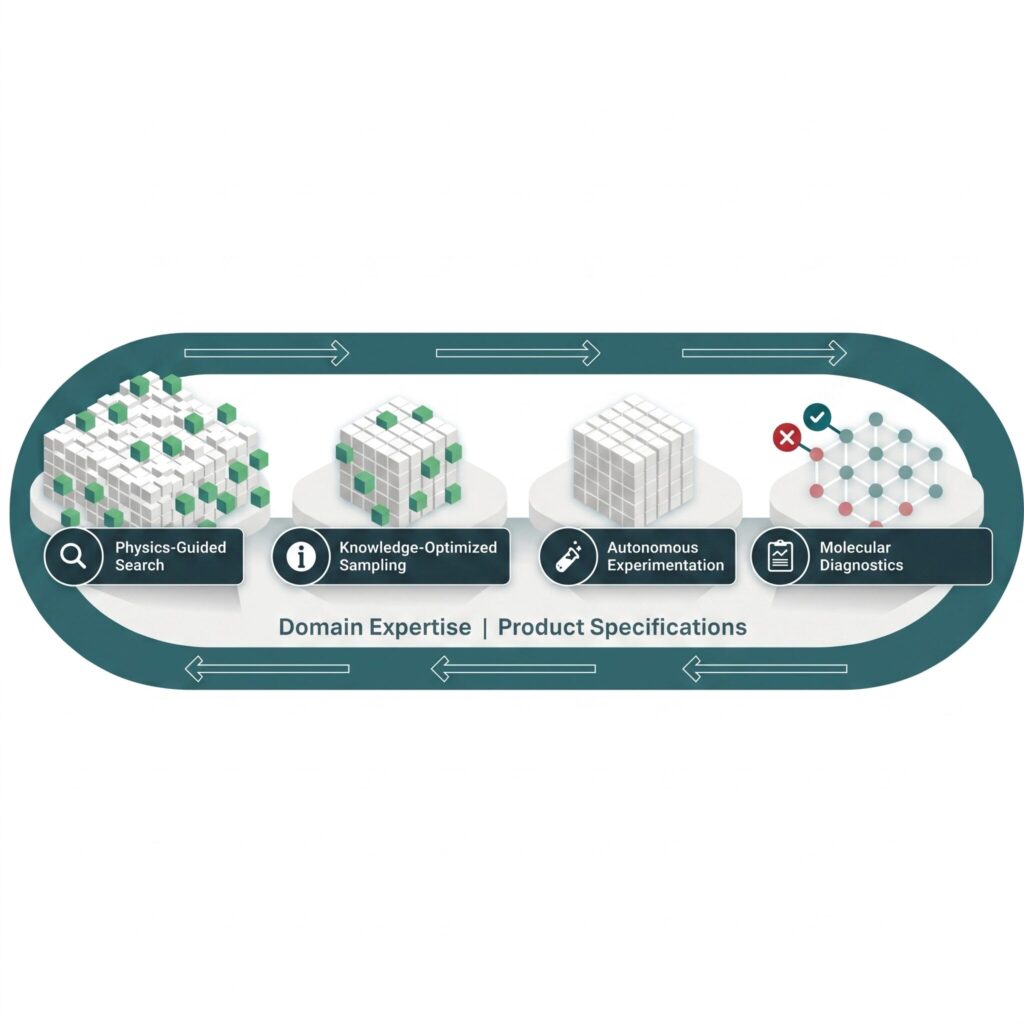
In 2020, we began developing an alternative approach — one that leverages the speed and power of AI and computation, integrating them with real–world battery performance and data. The result is a physics-informed AI platform that compresses the development cycle down from more than a decade to just 12 to 18 months. Thisplatform operates as a closed learning loop comprising four connected stages, all underpinned by deep, battery-specific domain expertise.
An Integrated Platform
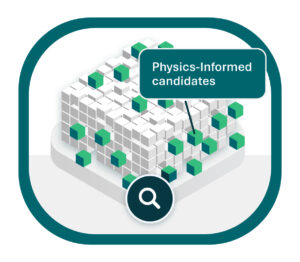 Physics-Guided Search. The combinatorial space of possible batteries is impossibly large. It consists of trillions of combinations of salts, solvents, additives, electrode materials, dopants, and processing conditions across each subsystem. Because the cathode, anode, and electrolyte must be chemically and electrochemically compatible, these subsystem spaces multiply together rather than being additive. Consequently, the effective search space for a viable battery product is trillions compounded upon trillions. No amount of brute-force experimentation can effectively navigate this complexity. No amount of purely data-driven AI can navigate it either: the space is too sparse, and the signal too noisy.
To unlock the awesome pattern-recognition capabilities of AI and ML, the system requires guidance. Physics is the key to making this process tractable. Quantum mechanical simulations, density functional theory, and molecular dynamics applied across multiple length scales eliminate candidates that are thermodynamically unstable, electrochemically incompatible, or mechanistically implausible. Furthermore, performance specifications, material availability, synthesis feasibility, and manufacturing costs serve as additional constraints, narrowing down the most viable options.
Through this rigorous filtering process, trillions of possibilities are distilled into thousands. This entire foundation of computation and simulation rests upon both publicly available electrochemical data and years of our proprietary data detailing molecular and electrochemical battery behavior.
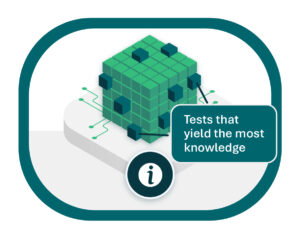
Knowledge-Optimized Sampling. The filtered space from the first step remains too large to test exhaustively. Therefore, our AI selects the optimal set of experiments to execute. Most importantly, it does not select those most likely to yield the best single result, but rather those poised to yield the most valuable information.
Optimizing for a single best result tends to trap the search within a local maximum; conversely, optimizing for information gathering expands our understanding of the entire space and accelerates convergence towards the true overall optimum including successive iterations.
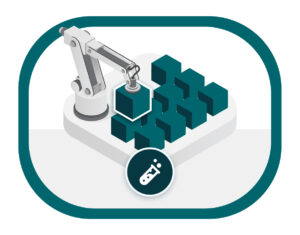
Autonomous Experimentation. Since batteries are physical products, no amount of simulation replaces real-world data. Our robotic systems run experiments around the clock under rigorously controlled, consistent conditions. Consistency matters just as much as speed: by eliminating human-to-human variability in cell assembly, electrolyte preparation, and testing, the signal in the resulting data is cleaner and more comparable across all candidates. As a result, fewer experiments are required to draw confident, actionable conclusions.
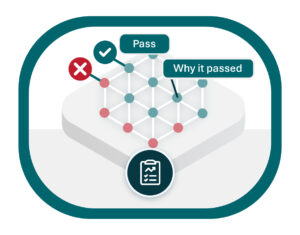 Molecular Diagnostics. This is where the platform’s compounding advantage resides. When a cell underperforms, or overperforms, the key question is not simply whether it passed or failed, but which internal process drove the result (such as anode interfacial reactions, cathode kinetics, or electrolyte transport) and what that implies for subsequent adjustments. Standard cycling data reveals what happened, but not why. However, non-destructive, in-situ diagnostics, run during normal cycling, can provide these answers. They produce an electrochemical fingerprint for each cell, enabling both diagnosis (what occurred and where) and predictive ranking (comparing candidates early in their lifecycles to predict long-term performance without waiting months). Moreover, ex-situ materials characterization operates on a slower, campaign-level loop alongside these continuous diagnostics. While destructive, it provides molecular-level root-cause confirmation when the electrochemical signal needs verification.
The key is to integrate both in-situ and ex-situ diagnostics to generate a complete picture, and then seamlessly feed that information back into the platform. These four processes form a tight, closed-loop learning system. Each experiment refines the next selection; each diagnostic output updates both the physics-guided filter and the AI’s understanding of the chemistry. Consequently, the platform becomes more intelligent with every iteration.
Domain Expertise & Product Specifications. Battery-specific knowledge underpins every stage of our process. While physics constrains what is possible, domain expertise constrains what is meaningful in a battery context — determining which failure modes matter, what diagnostic patterns mean, how coin cells translate to pouch cells, when a dataset can be trusted, etc. This expertise is proprietary, accumulated over years of building and diagnosing real cells, and cannot be short-circuited by capital alone.
Alsym’s output is a product: a better battery. Product specifications are essential because they inform the questions we ask, the priorities we set, and the evaluations we make. We set out explicitly to develop a safe, affordable battery chemistry. Achieving a deployable, non-flammable, long-lasting, and low-cost solution was not a happy accident of our chemistry choices; it was achieved by deliberate design.
Speed Through the Full Battery Development Cycle
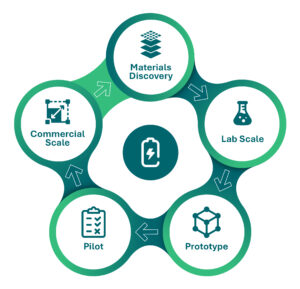
This platform approach becomes even more critical when transitioning from the lab to the pilot phase, and ultimately to commercial manufacturing. Every transition introduces new physical phenomena, higher costs, and slower iteration cycles. Lab results do not automatically translate to the pilot scale, and pilot results do not automatically translate to full-scale manufacturing. The physics, thermal gradients, material volumes, mechanical stresses, process tolerances, and physical machinery all change drastically. Historically, the battery industry was crowded with promising concepts that ultimately never scaled.
Our platform does not simply transfer results across scales; it transfers understanding. The electrochemical model built at the lab scale — identifying which processes are rate-limiting, which interfaces are most sensitive, and how the system responds to changes in conditions — serves as the foundational starting point for pilot-scale work and beyond, replacing the mere hope that initial lab data holds true. When results inevitably shift during the scaling process, the platform does not merely indicatethat something went wrong at a new scale. Instead, it reveals which internal process changed, why it changed, and what to adjust. Deviations from expected behavior are diagnosable immediately rather than being treated as new unknowns, ensuring that solutions are found faster and are more actionable.
The compounding advantage
Ultimately, the platform’s advantage is not just speed and scale: it is interpretation. Every experiment yields sufficient signal that fewer trials are required. Physics narrows the search before any cell is built; in-situ diagnostics close the learning loop during cycling; and domain expertise modulates every decision. Each cycle refines the next, and each failure informs the next candidate. Furthermore, each piece of organizational knowledge raises the baseline for future developments. This advantage compounds with every experiment run, establishing our approach as a uniquely durable innovation.
We are driven to provide affordable, safe energy to all. Time is the enemy, and our Physics-Informed AI platform for battery development is our strongest weapon to defeat it.